
What is fascia and why does it matter for equine performance?
When thinking about our horse’s health and performance, we often consider the muscles and joints - but one of the most underrated components of a horse’s performance health actually goes beyond just muscles and joints…
I’m talking about the fascia.
But what exactly is fascia?
In the most simplified explanation: fascia is the connective layer of tissue between the skin and the muscle 👇
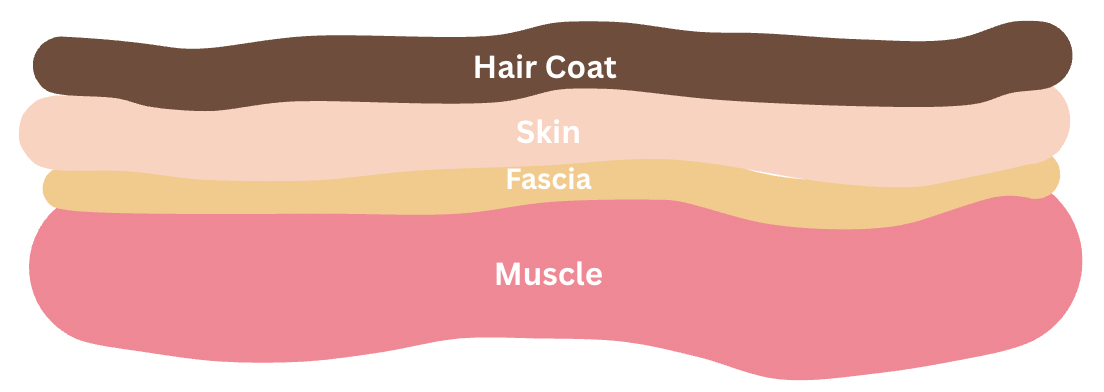
If we were to peel our horse apart layer by layer (in a cool, anatomical way - not a creepy way 😅) we would first remove their hair coat and see skin, then we would remove the skin and see a filmy, webbed looking substance that sits on top of (and in some cases encapsulates) the muscles - this is the fascia.
Fascia is the body’s largest sensory organ and creates the integrity of the body through one continuous webbed connection. It is what truly “holds” the body together - it does not have a distinct start and end, it is all-encompassing across the entire body with complex patterns and connections surrounding muscle fibers, organs, and other tissue.
So encompassing, in fact, that if you were to remove the horses’s bones and muscles but leave the fascia in place, you would have an almost perfectly shaped fascia-horse.
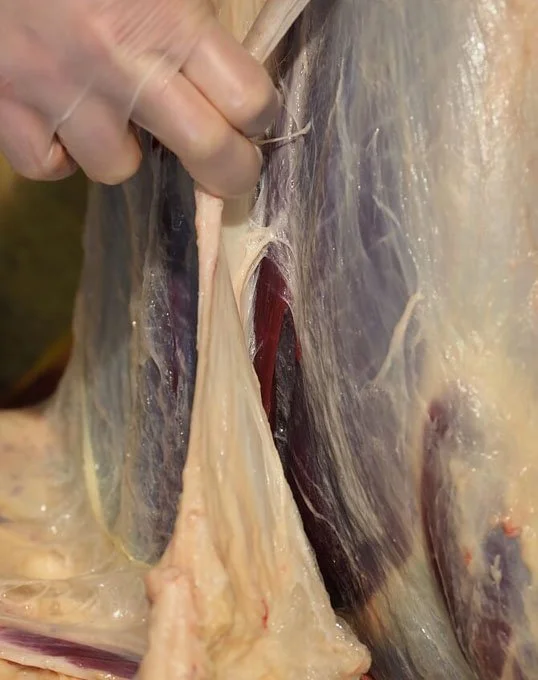
Photo courtesy of EuroDressage
Healthy fascia is well-hydrated, supple, and glides freely to allow complete range of motion within the horse.
Unfortunately, fascia faces many challenges in the body and can easily become disorganized and damaged from things like injury, compensatory movement patterns, pressure (tack fit), lack of movement (or lack of correct movemet) and more.
Once damaged, fascia has a very difficult time returning to normal and can result in decreased range of motion. The body adapts to these restrictions quickly and new, restrictive patterns form throughout the horse’s entire system (remember - fascia connects the whole body so even if the original issue is in the hind end, it can present in the front end very easily).
I like to picture it like a knit sweater air-drying on a hanger next to a tree. If the sweater sways in the wind and catches a branch, it will pull a thread or more out of place and the sweater will become misshapen. If someone immediately notices and pulls the sweater off the tree - the snag is still there but can be repaired with careful manipulation (more on that in a moment). But If no one notices the sweater stuck on the branch, the snag will become worse and the sweater will continue to become more and more misshapen until it becomes nearly unfixable.
Now, take a moment to remember a time when you’ve tried to fix a snag on a knit sweater.
How did you approach it? Smash the thread around or delicately try to smooth it back from where it came? Or did you just pull out as much as you could and then cut off the loose thread? Did it ever look quite exactly the same?
Fascia works in much the same way. It’s delicate and doesn’t just snap back like we want it to.
The manipulation of fascia cannot be rushed, it must be asked to reform slowly and with great care. This can take multiple sessions and quite honestly, often looks like watching paint dry - fascial work is so slow and intentional that it often looks like you’re not doing anything at all.
So how does all of this relate to performance?
It’s a dangling carrot of knowledge for you the next time you notice your horse is walking ‘weird’, not tracking up, or has developed some kind of compensatory movement - I encourage you to consider the effect that fascia has on their movement and range of motion and not just what the muscles and joints are doing.
And, as always, when in doubt - call in a trusted bodyworker for guidance!
Interested in learning more about fascia? A few of my favorite resources are:
Gillian Higgins ‘All About Fascia’ Seminar (7 hours of education, about $160)
Gillian Higgins ‘Understanding Muscles and Fascia’ (2.5 hours of education, about $15)
Equine Myofascial Kinetic Lines (book, cost varies)
