
Do training aids really help horses move correctly?
If you don’t feel like reading today, I’m gonna give you the short answer: no.
Now, hopefully your curiosity is piqued and you want to learn more 😉 Read on below…
If you’ve been an equestrian for more than 5 minutes, you’ve probably been recommended to use some sort of artificial training aid during your riding career.
Artificial training aids include anything beyond your body (voice, seat, hands, legs) that you use to communicate with the horse.
Examples: whips, spurs, training sticks, ropes, martingales, tie downs, Pessoa, bungee bands, draw reins, brain chains, etc.
For the purpose of this blog - we’re going to be focusing on aids that create a specific desired movement, frame, or headset.
[Side note: if you are interested in learning more about the affect of spurs on a horse, Ciara with Sozo Equine has some fascinating dissection footage of scarring on the muscles of the barrel from spur use - video here].
The most common restrictive aids in the equestrian world are: martingales, tie downs, draw reins, and the Pessoa system.
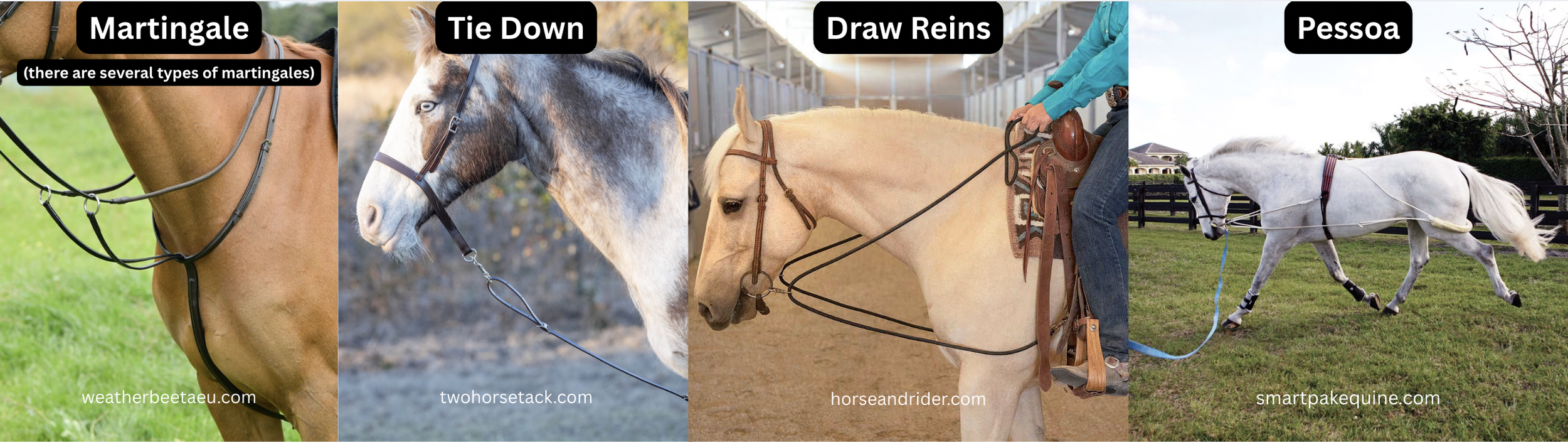
The goal of these aids is to either create or prevent a certain movement of the horse.
For example: If your horse pulls at the bit or wants to hold their nose high, you can visualize how a martingale, tie down, or draw reins would theoretically limit the horse’s ability to do so and keep them in a “correct” frame.
If your horse wants to move out head-high with a hollow back, you can visualize how the Pessoa would theoretically require the horse to engage and lift the back to build the topline.
Key word above: theoretically.
In practical application, however, what we create is compliance without strength. When we force a horse into a specific frame, their body finds a way to make it work but that doesn’t mean that it’s creating correct movement.
I’m a visual learner so it helps me to cross-reference things like this with something I can tangibly reference.
So, I want you to enter an imaginary world with me for a moment:
Imagine that your doctor told you you need to keep your neck perfectly straight in order to keep your spine aligned for good posture. When you tilt your head down to look at your phone or look right and left over your shoulders, you’re affecting the straightness of your spine (and in this imaginary world, we want straightness! Straightness = correct).
So, visualize that your doctor puts you in a stiff neck brace so that you cannot move your neck up, down, left or right. This is a good thing! Restricted movement means a straighter neck = correct posture.
Your doctor says to go live life as usual and that over time, the neck brace will teach you how to keep your neck straight on your own. So, you go do your usual things!
You unload the dishwasher, pick kids up and down, throw saddles, bend over to pick weeds, work on your computer etc. At first it’s easy, your body can easily compensate for not being able to move your neck…
But after some time, do you start to ache between your shoulder blades? What about your lower back? Does your neck get tight from fighting the resistance of trying to look left, right, up or down? Do you feel a headache coming on from having to move your eyes in unnatural ways since you can’t turn your head? Yes.
Instead of acheiving the doctor’s goal of “training” your neck by building strength to keep your it straight and in “good” posture, your body compensates and the while the muscles of your back grow and get stronger… your actual neck muscles do nothing and in fact get weaker. The brace keeps you “correct” while you’re wearing it, but it teaches your body nothing. Your body is left weak, confused, and compensating in the wrong places.
—-
The same is true for our horses. When we use these “aids” we simply shift their effort to another part of the body… they are able to do the task and look “correct” doing it but the aid is not actually addressing correct movement, nor is it helping the horse retain that movement once the aids are removed.
So, what’s the alternative?
The alternative, like many things in life, is harder. Instead of being able to slap on a tie down or martingale and “fix” the problem in a single ride - the alternative means teaching our horses how to move correctly over time and with correct training.
In practical terms, this means lots and lots of groundwork. And not just tossing your horse in a round pen and saying “Yee-haw, go run around, Fluffy!” but intentional, slow, meaningful groundwork. It means studying how your horse moves and teaching them how to self-correct at a walk, trot, and canter.
Some of the things I encourage you to look for and address during groundwork are:
Do they bow out or in on a circle? Is it consistent or random?
Do they rush or stumble through transitions?
Do they drag their feet or really lift and flex through their joints?
Can they stop with ease?
Do they primarily hold weight in their forehand or hind end when changing direction?
Once you are able to identify these patterns… you can begin to address them.
If this is something you need support with, I’m here to help! Ask about groundwork consultations at your next session.
Some other great resources and courses on correct groundwork can be found through Amy Skinner and Feelin’ Fine Equine.
